
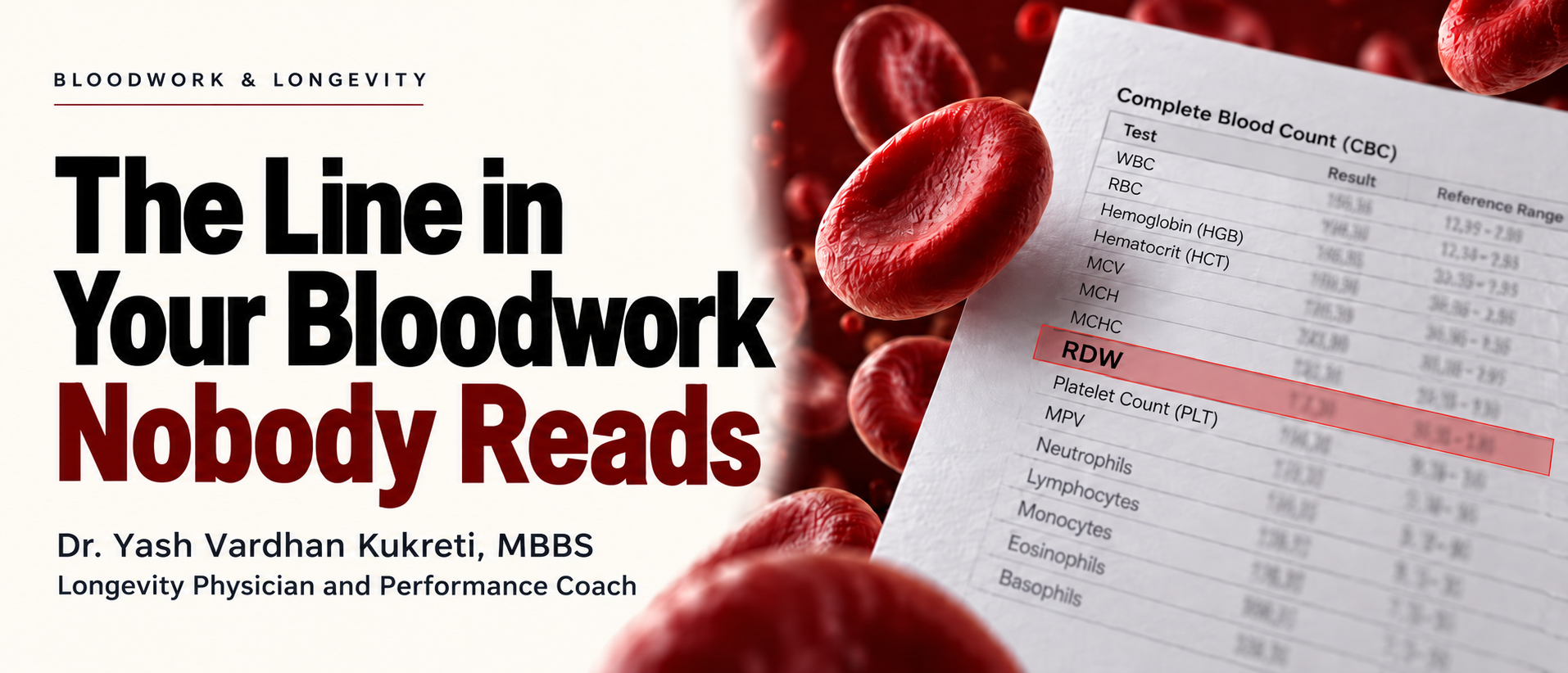
Dr. Yash Vardhan Kukreti, MBBS
Longevity Physician and Performance Coach
It’s on every blood count you’ve ever done. It costs nothing. And almost nobody, including a lot of doctors, ever look at it.
I have looked at a lot of blood reports. Mine, my clients’, and the ones athletes forward at 11 pm asking if they should be worried.
Almost everyone goes straight to haemoglobin. Then ferritin, maybe vitamin D, maybe testosterone if they lift. Nobody scrolls down to the little line sitting quietly under the red cell indices.
RDW. Red cell distribution width.
It costs you nothing extra. It is printed on every complete blood count you have ever done. And it might be one of the most underrated numbers in performance and longevity medicine.
I ignored it for years too. Then I read the data. Here is why I never skip it now.
What RDW actually measures
Your red blood cells are not supposed to be identical, but they are supposed to be similar. RDW tells you how similar.
Think of it like a squad lining up for a team photo. MCV, the number most people know, is the average height of the squad. RDW is how much the heights vary. You can have a perfectly normal average and still have a few giants and a few very short players hiding in the line.
Technically, RDW is the spread of red cell sizes expressed as a percentage of the average size. Most labs call roughly 11.5 to 14.5% normal, though the exact range depends on the machine your lab uses.
A high RDW means your bone marrow is releasing cells of very different sizes. That happens when something is disturbing production or clearance. Not enough iron. Not enough B12 or folate. Inflammation. Blood loss. A marrow that is getting older and sloppier.
In other words, RDW is less a diagnosis and more a smoke detector.
Why longevity researchers got obsessed with it
For decades, RDW had one job: helping doctors sort out the type of anaemia. Then researchers started looking at it in people who were not anaemic at all.
In 2009, a team at the US National Institute on Aging followed 8,175 adults aged 45 and over. For every 1% rise in RDW, the risk of dying from any cause went up by 22%. That held after adjusting for anaemia, nutrient levels and the usual risk factors. People with no anaemia showed the same pattern.
Let that sink in. A number your lab prints for free, on a report most people skim, was quietly carrying information about how long they would live.
The finding has since repeated across heart failure, coronary disease, stroke, cancer and infection. And when Morgan Levine and colleagues built Phenotypic Age in 2018, one of the most widely used blood based measures of biological ageing, RDW made the final cut. It is one of only nine blood markers in the formula, sitting next to albumin, glucose, CRP and creatinine.
Why would cell size variation predict how long you live? The honest answer is we are still working it out. The leading ideas:
- Inflammation blunts the marrow’s response to the hormone that makes red cells and locks iron away, so production becomes uneven.
- Oxidative stress damages cells and shortens their life.
- Slower clearance of old red cells lets small, aged cells pile up and widens the spread.
- Ageing of the marrow itself, including clonal changes in blood stem cells, shows up in the cells it makes.
RDW does not cause any of this. It reflects it. That distinction matters, and I will come back to it.
Why this matters if you train
Athletes are exactly the population where RDW earns its keep, because we stress the red cell system in ways sedentary people never do.
It can flag iron trouble early. When iron starts running low, the marrow begins making smaller cells. Those new small cells mix with your older normal ones, and RDW widens. This often shows up before haemoglobin drops and before MCV moves. If you are an endurance athlete, a woman who trains hard, or someone eating mostly plant based, a rising RDW with a falling ferritin is a pattern worth catching early.
It catches the mixed deficiency trap. Low iron shrinks cells. Low B12 or folate swells them. Have both and your average cell size can look perfectly normal, so MCV tells you nothing. RDW is the giveaway, because now you have small cells and big cells in the same sample. Vegetarian athletes in India, this one is for you.
It moves with heavy training and altitude. Altitude blocks, big training camps and repeated foot strike in runners all ramp up red cell turnover. Young cells are larger, so RDW can creep up for reasons that are perfectly healthy. Context matters.
It reflects how well you are recovering. If your training load is high and your recovery is not, systemic inflammation stays elevated. Over time that can show up as a wider RDW. It is one more signal, alongside resting heart rate, HRV and sleep, that you are digging a hole faster than you are filling it.
One reading means very little. A trend across a season tells you a story.
So what do you do with your number?
Pull up your last blood report. Find RDW. Then read it alongside its neighbours, never alone.
| What you see | What it often points to |
|---|---|
| High RDW, low MCV | Iron deficiency, the most common pattern in athletes |
| Normal RDW, low MCV | Often a thalassaemia trait, which iron will not fix |
| High RDW, high MCV | B12 or folate deficiency, or alcohol |
| High RDW, normal MCV | Early iron deficiency, or iron plus B12 deficiency together |
| Normal RDW, normal everything | Good. Keep tracking it |
That second row matters a lot in South Asia, where thalassaemia trait is common. I have seen people take iron for years for small red cells that were never about iron.
Now the part where I will disappoint some of you: you cannot supplement your way to a better RDW. There is no RDW pill. Chasing the number is like taping over the smoke detector. You find the fire.
What actually helps:
- Test before you take anything. Ferritin, iron studies, B12, folate and a CRP. Iron in particular should be replaced only when it is actually low, because extra iron is not harmless.
- Fix the real deficiency, then retest in 8 to 12 weeks. RDW lags behind treatment because old cells take about four months to cycle out.
- Eat enough to cover your training. Underfuelling is one of the most common hidden drivers of poor iron status and low grade inflammation in athletes.
- Take recovery as seriously as training. Sleep, deloads, and managing total stress all lower the inflammatory background RDW seems to reflect.
- Track the trend, not the snapshot. Same lab, similar time of day, similar point in your training cycle.
If your RDW is persistently high and nothing above explains it, that is a conversation for your doctor, not your group chat.
The best athletes I know are not the ones with the most supplements. They are the ones who read their own data properly. RDW is a small number. Start reading it.
The 30 second version
- RDW measures how much your red blood cells vary in size. It’s on every CBC, free.
- In a study of 8,175 adults, every 1% rise in RDW meant a 22% higher risk of death from any cause.
- It’s one of only nine blood markers used to calculate Phenotypic Age, a leading measure of biological ageing.
- In athletes, it can flag low iron before your haemoglobin drops.
- There is no pill for RDW. Find what’s driving it and fix that.
Go check your last report. Then send this to the friend who trains harder than they recover.
References
- Patel KV, Ferrucci L, Ershler WB, Longo DL, Guralnik JM. Red blood cell distribution width and the risk of death in middle aged and older adults. Arch Intern Med. 2009;169(5):515 to 523.
- Levine ME, Lu AT, Quach A, et al. An epigenetic biomarker of aging for lifespan and healthspan. Aging. 2018;10(4):573 to 591.
- Perlstein TS, Weuve J, Pfeffer MA, Beckman JA. Red blood cell distribution width and mortality risk in a community based prospective cohort. Arch Intern Med. 2009;169(6):588 to 594.
- Higgins JM, Mahadevan L. Physiological and pathological population dynamics of circulating human red blood cells. PNAS. 2010;107(47):20587 to 20592.
This article is for education and is not medical advice. Get your bloodwork interpreted by a qualified clinician.